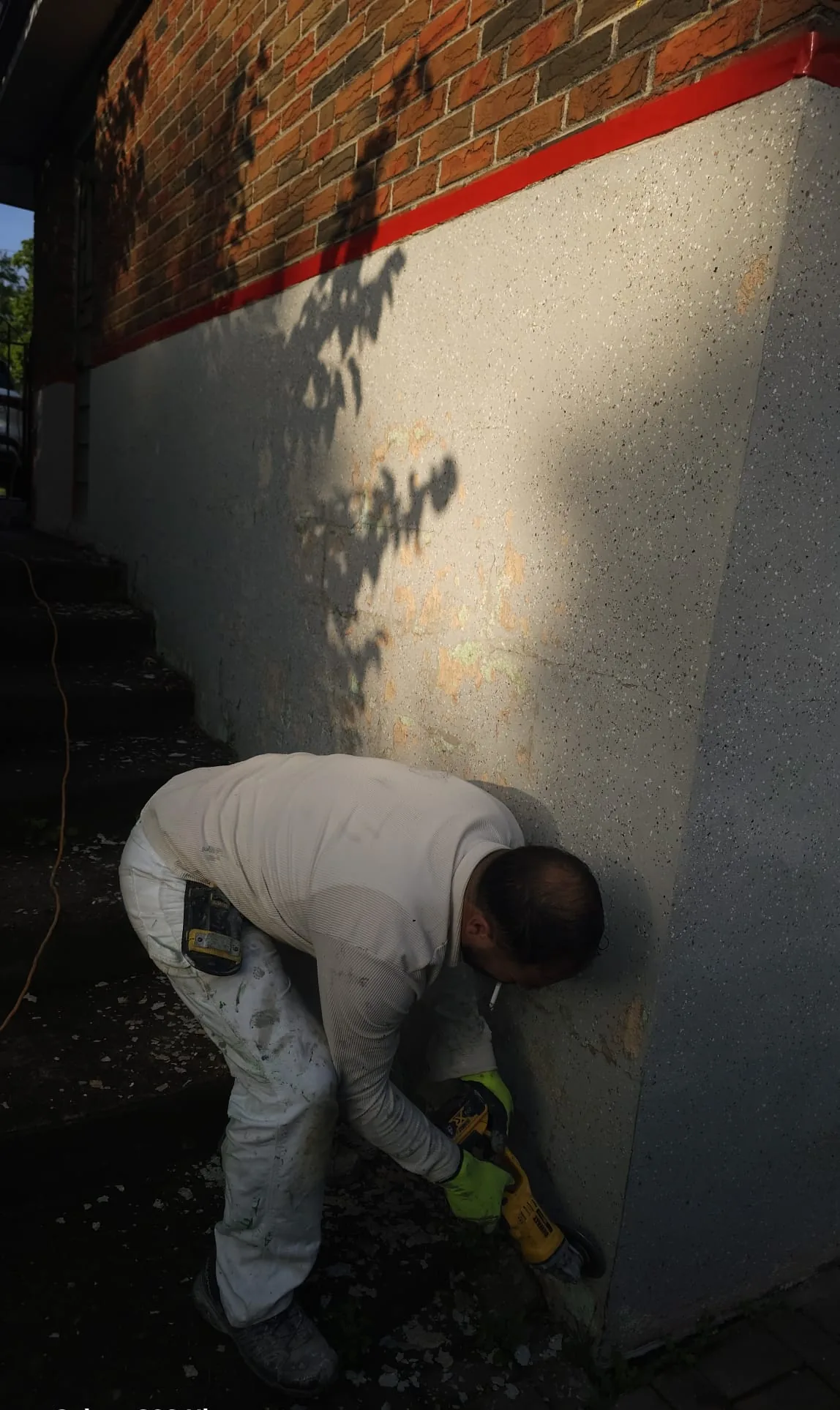
Read the pattern before you read the price
Not all stucco cracks mean the same thing, and the shape tells you most of what you need to know. Before anyone quotes you, walk the wall and work out which of these you have — it is the difference between a cosmetic repair and a wall that is taking on water.
Usually surface-level
- Fine map or spider cracking spread evenly over an area — often shrinkage in the finish coat
- Hairlines you cannot catch a fingernail in, with no staining around them
- Short cracks at a single patch edge where an old repair meets original work
Take these seriously
- Diagonal cracks running off window and door corners — the classic stress point, and a direct path for water into the opening
- Long horizontal cracks following a floor line or a joint in the sheathing behind
- Cracks with dark staining or streaking below them — water has already been running in
- Any crack you can fit a fingernail into, or that has opened over one season
- Cracking together with a hollow or bulging area
The corner cracks matter more than their size suggests. A window opening concentrates stress at its corners, so that is where a wall gives first — and it is also the one place where a crack sits directly over the join between the cladding and the window, which is the least forgiving detail on the whole elevation.
The test that decides patch or replace
Cracking tells you the surface has moved. It does not tell you whether the stucco is still stuck to the wall — and that is the question that decides what the repair actually is.
The knuckle test
Tap along the wall with a knuckle or the handle of a screwdriver, every foot or so, working outward from the cracked area. Solid stucco gives a sharp, dense tap. Debonded stucco sounds dull and drummy — hollow. Chalk the hollow spots and step back. If the hollow area extends well past the visible cracking, the crack was a symptom, not the problem: the stucco has released from the wall behind it and no amount of filling the crack will hold.
This is the single most useful thing a homeowner can do before getting quotes, and it costs nothing. It also tells you very quickly whether the contractor in front of you is being straight with you — anyone quoting a crack fill on a wall that sounds hollow across half an elevation is quoting the cheap version of a job that will fail.
How to tell if water is already getting in
Stucco and EIFS are not waterproof membranes; they are the outer face of an assembly that is supposed to shed water and let anything that gets past drain back out. Cracks matter because of where the water goes next, not because of how they look.
- Staining or streaking below a crack — run-off has been tracking through it
- Dark patches that stay damp longer than the wall around them after rain
- Blistering, bulging or a soft spot next to the crack — the substrate behind may be wet
- Interior signs on the same elevation: staining at a window head, damp drywall at a corner, or paint lifting on an inside wall after wind-driven rain
- Efflorescence — white powdery deposits — meaning water has moved through the material and evaporated out
Interior signs on the same wall as exterior cracking is the combination worth acting on quickly. By then the question is no longer the finish; it is what the water has been doing to the sheathing and framing behind it.
Why filled cracks keep coming back
Almost everyone tries caulk or a filler first, and on genuinely cosmetic hairlines that can be reasonable. It fails on structural cracks for three reasons worth understanding before you pay for it twice.
- The movement did not stop. A crack at a window corner is there because that corner concentrates stress. Fill it and the wall still moves, so it reopens — usually along the same line, often within a season.
- Filler has no reinforcement. What controls cracking in stucco and EIFS is fibreglass mesh embedded through the base coat, tying the face together as one reinforced sheet. Filler dropped into a crack does not reinforce anything.
- The repair was never bonded. Material applied over a dusty, painted, sealed or debonded surface has nothing to grip. It looks right on the day and lets go at the edges within a couple of freeze–thaw cycles.
Ontario winters are unusually hard on this. Water gets into a crack, freezes, expands, and levers the crack wider — then the cycle repeats, often dozens of times in a season. A crack left through one winter is generally not the same crack in spring.
What belongs in a proper repair scope
A written scope should say what happens at each stage, not just "repair stucco". These are the steps that decide whether the repair lasts.
01Sound out and cut back
Tap the whole elevation, mark the hollow areas, and cut the material back to where it is genuinely bonded. This step decides the outcome and it is the step that gets skipped.
02Open the crack, do not just cover it
Structural cracks are cut out to a proper profile so the repair material has a key to grip, rather than being skimmed over.
03Mesh through the repair
Fibreglass mesh embedded in the base coat and carried well past the crack on both sides — that overlap is what stops the crack reappearing along the old line.
04Deal with the detail that let water in
Flashing, sealant joints and the window and door perimeters get addressed at the same time. Repairing the field while leaving the interruption open just moves the problem.
05Finish and blend
Finish coat worked to match the existing texture and colour as closely as the material allows, carried to a natural break in the elevation rather than stopped in the middle of a wall.
On colour matching
A repair patch in the middle of a weathered wall will show, however well it is troweled — existing stucco has years of UV and dirt on it that new material does not. Good repairs are carried to a corner, a joint or a change of plane so the eye reads a whole surface rather than a patch. Ask where the repair will stop before you agree to it.
What to ask before you hire
- "Did you sound the wall?" If nobody tapped it, nobody knows how much is debonded — and the quote is a guess.
- "How far past the crack does the mesh go?" A specific answer means they intend to reinforce it. A vague one means filler.
- "Is this stucco or EIFS?" These behave differently and repair differently. A contractor who cannot tell you which you have should not be cutting into it.
- "What are you doing about the window perimeters?" Corner cracking and open perimeter joints usually travel together.
- "Where does the repair stop?" The answer should be a corner or a joint, not an arbitrary line.
- "What happens if it reopens?" A workmanship warranty means they expect it to hold.
Where FAIME fits
Stucco, EIFS and crack repair are self-performed FAIME scopes — the trades we do with our own crews rather than subcontracting — across Toronto, North York, Scarborough, Vaughan, Richmond Hill, Markham, Mississauga, Brampton and the wider GTA.
We do not quote stucco repair from photographs. A photo cannot be tapped, and the two things that decide the scope — how much is debonded, and whether the detail above the crack is open — are exactly what a photo hides. The site visit is free and carries no obligation, and we will tell you when a crack genuinely is cosmetic.
- $2M general liability · Active WSIB (Class G5) · 2-year workmanship warranty
- Durabond and Sto systems for stucco and parging
- Written scope before work starts, including where the repair stops
Our Scarborough stucco refinishing project shows this sequence on a real house — ground back, meshed, tinted finish, then base caulking — and the Innisfil EIFS transformation shows what happens when the wood behind the finish has already gone. If you want a wall looked at, the stucco and EIFS repair page has the site-visit form.