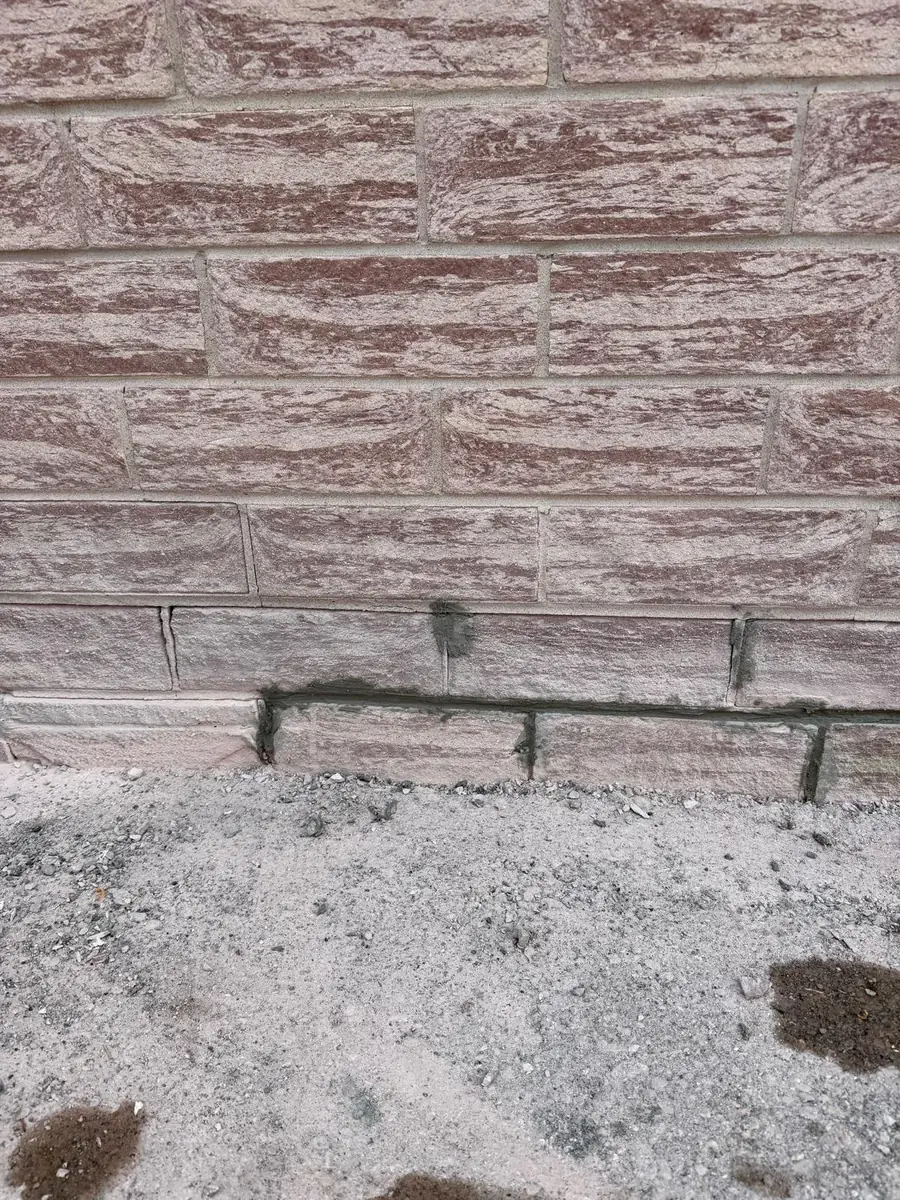
What the white powder actually is
Brick, mortar, concrete, stucco and parging all contain water-soluble salts. When water gets into the material, it dissolves those salts and carries them toward the surface. When the water reaches the face and evaporates, the salts stay behind as a white, crystalline, often fluffy deposit. That deposit is efflorescence.
So efflorescence always needs three things at once: salts in or behind the material, water to dissolve them, and a path for that water to travel out and evaporate. Take away the water and the bloom stops. That is why the useful question is never "how do I get rid of the powder" but "why is this part of the wall wet".
Usually harmless
- A light, even bloom on new brickwork or fresh stucco, sometimes called new-building bloom, which tends to fade as the wall dries out
- A one-off bloom after a very wet spell that brushes off and does not come back
- Powder that dissolves in water and brushes away dry
Worth investigating
- The same patch returning season after season, which means a water source that has not gone away
- Efflorescence concentrated below a window, a sill, a cap or a joint, pointing straight at the detail letting water in
- Heavy deposits at the base of a wall or on a foundation, suggesting splashback or ground moisture wicking up
- Flaking, crumbling or spalling brick face where the bloom forms
- A hard white crust that does not brush off (see below)
A two-minute test to tell what you have
Not every white mark on a wall is efflorescence, and the difference changes what you do about it.
Brush, then wet
Try a dry, stiff brush on the deposit first. Efflorescence is soft and powdery and mostly brushes away. Then put a few drops of water on what is left: efflorescence salts dissolve. A deposit that is hard, crusty and runs in streaks from a joint or crack, and does not brush off or dissolve, is more likely lime run (calcium carbonate), which forms when water leaches lime out of mortar or concrete and it hardens on the face. Lime run points to the same kind of water problem, but it is much harder to clean off and usually needs a professional. Fuzzy, grey-green or black growth is not efflorescence at all. It is organic growth and has a different fix.
Where it shows up tells you where the water is
Efflorescence is a map of where water is moving through your wall. Reading where it forms is usually the fastest way to find the leak behind it.
- Under windows and sills. Failed or missing caulking at the window perimeter, a sill with no slope or drip, or a sill joint that has opened up. Water runs in at the sill and comes out as a bloom below it.
- Below the top of a wall, a parapet or a ledge. A missing or failed cap, coping or flashing letting rain straight into the top of the masonry.
- Around downspouts and gutters. An overflowing gutter or a downspout discharging against the wall keeps one section soaked.
- At the base of the wall and on foundations. Splashback from hard paving, soil or mulch piled against the wall, or ground moisture wicking up through the foundation and parging.
- Along a vertical line or joint. A control joint whose sealant has failed.
- Inside a basement. On a foundation wall indoors it means water is moving through the foundation from outside. That is a waterproofing and drainage question, not a finishing one.
How to clean it without making it worse
Cleaning off efflorescence is easy. Cleaning it off in a way that does not push more water into the wall takes a bit of restraint.
- Wait for a dry spell and dry-brush it. A stiff natural or nylon brush removes most efflorescence. Avoid wire brushes on soft brick or stucco finishes, which scratch the face.
- If you need water, use as little as possible. A light rinse after brushing, then let the wall dry fully. Soaking the wall re-dissolves salts deeper in the material and brings a fresh bloom back out.
- Do not pressure-wash it. High pressure drives water deep into masonry and joints, which feeds the next round of efflorescence and can damage mortar and softer brick.
- Be careful with acid cleaners. Diluted acid products can remove stubborn deposits and lime run, but they can etch brick, burn mortar joints and discolour the wall. They are a product-specific, test-patch-first job, not a first resort.
What not to do: sealing over it
The most common mistake is to clean the bloom off and then coat the wall with a sealer or paint that does not let moisture out, on the theory that the wall will then stay clean. It usually makes things worse.
If water is still getting into the wall and can no longer evaporate from the face, the salts crystallise just behind the surface instead of on it. Crystals growing under the face push it off: brick spalls, parging lets go in sheets, and paint or coating lifts off the wall. That damage is permanent, where the efflorescence was not. Masonry and cementitious finishes need to stay vapour-permeable. Any coating that goes on them has to be chosen for that, and only once the water source is fixed.
Fixing the cause, not the powder
A lasting fix is always about the water. Depending on what the pattern points to, that means:
01Find the source from the pattern
Walk the wall after rain and note where the bloom forms relative to windows, sills, caps, joints, downspouts and grade. The pattern is usually specific enough to point at one detail.
02Redo failed sealant and caulking
Cut out failed window perimeter caulking and control-joint sealant back to clean surfaces and run new joints properly. Do not caulk over the old bead.
03Repair the masonry and stucco
Repoint open or eroded mortar joints, replace spalled units, and repair cracked stucco and parging so water is not getting straight in through the face.
04Deal with water at the top and bottom
Caps, copings and flashings at the top of the wall, and splashback, grading and downspout discharge at the base.
05Let it dry, then clean and finish
Give the wall time to dry out, dry-brush the remaining salts, and only then apply any breathable finish or coating.
Where FAIME fits
Stucco and brick repair, parging, joint sealants and window caulking, and exterior painting are all self-performed FAIME scopes across Toronto, North York, Scarborough, Vaughan, Richmond Hill, Markham, Mississauga, Brampton and the wider GTA. Efflorescence is usually a sign that one of those details has failed.
On our Vaughan commercial envelope project, the order of work was exactly the one above: brick and stucco repairs, old penetrations removed and patched, every joint sealant and window caulking line cut out and redone, and only then the finish coats and paint. Our foundation refinishing project shows the same logic at the base of a house.
We do not diagnose from photographs, because the pattern is only half the story. The other half is what the wall sounds and feels like, and what the details above it are doing. The site visit is free, and we will tell you if a bloom is cosmetic and will fade on its own.
- $2M general liability · Active WSIB (Class G5) · 2-year workmanship warranty
- Written scope before work starts, naming the water source we are fixing