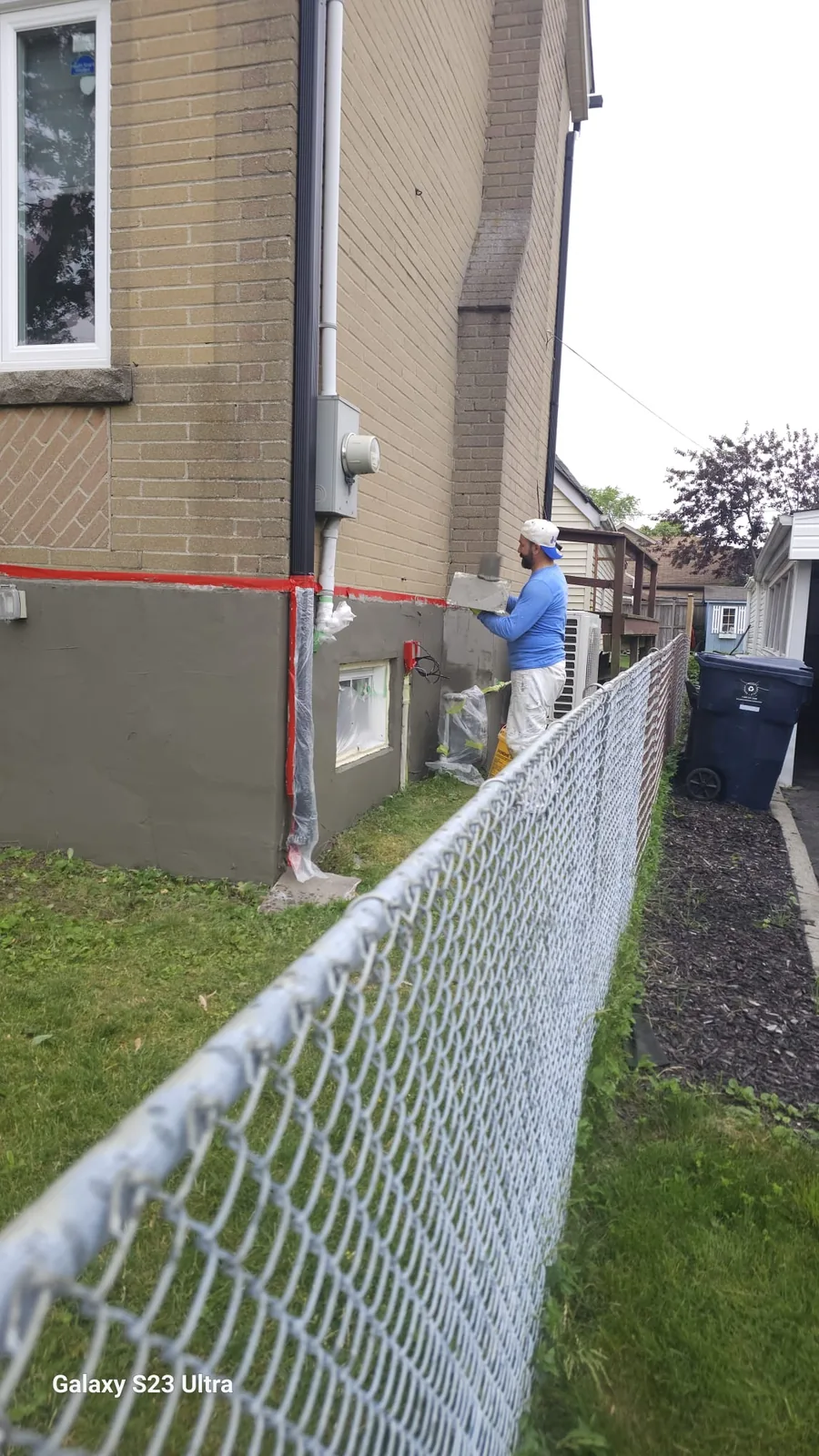
What parging actually does — and what it does not
Being clear about this up front saves a great deal of money, because most bad parging jobs are bought to solve a problem parging cannot solve.
What parging does
- Protects exposed block or concrete from weathering and freeze–thaw damage
- Evens out an irregular surface into a clean, uniform face
- Covers old veneer scars, tie holes and patchwork
- Gives the base of the wall a finished, tintable surface
- Sheds surface water off the visible face
What parging does not do
- Waterproof a basement. Below-grade water is a drainage and membrane problem.
- Repair structural cracking or movement in a foundation
- Stop water entering through a crack that runs through the wall itself
- Substitute for grading, weeping tile or downspout correction
- Last indefinitely over a surface it was never bonded to properly
If a contractor offers parging as a fix for a wet basement, that is the moment to stop and get a second opinion. The parging may well need doing — but it is not what will keep the basement dry.
Five signs it needs redoing, not patching
Patching is legitimate and often the right call. These are the conditions where patching becomes a recurring expense instead:
- It sounds hollow. Tap along the wall with a knuckle or a screwdriver handle. A dull, drummy sound means the parge coat has released from the substrate behind it. Hollow areas will keep spreading at the edges no matter how neatly you patch the hole in the middle.
- It comes off in sheets rather than crumbs. Surface erosion is wear. Sheet failure is a bond failure — usually because the original coat went onto a dirty, sealed, painted or unprepared surface.
- Spalling at corners and along the grade line. The bottom edge and the outside corners take the most freeze–thaw punishment. Once those are breaking down over a run rather than at one spot, the coat is at the end of its life.
- Repeated patches that keep failing at the same seam. Every patch edge is a new failure line. Three patches on one elevation usually costs more, cumulatively, than taking the wall back once and redoing it properly.
- Old stone or brick veneer coming away. Where a decorative veneer was applied over the foundation and is now loose, the correct sequence is strip it, repair what is underneath, then rebuild the surface — not parge over the top of a failing veneer.
The knuckle test
Walk the full perimeter and tap every metre. Mark the hollow spots with chalk. If the hollow areas add up to more than roughly a third of an elevation, you are looking at a re-parge of that elevation rather than a patch — and any contractor telling you otherwise is quoting the cheap version.
If your parging is already cracking or coming off, the five usual causes tell you whether a patch will hold.
What belongs in a proper parging scope
Parging is unusually dependent on preparation. The material is not complicated; the bond is everything. A written scope should name these:
01Strip and sound out
Remove all loose, hollow and debonded material back to sound substrate. This step is what the job lives or dies on, and it is the step that gets cut.
02Clean and prepare
Remove dirt, old coatings and anything that will prevent a mechanical bond. A previously painted or sealed foundation needs different preparation from a bare one.
03Repair the substrate
Fill voids, repoint open mortar joints and address cracks in the wall itself before anything is coated over them.
04Reinforce where needed
Mesh across transitions, repair boundaries and corners, so the new coat spans the joints between old and new rather than cracking along them.
05Base coat to plane
Build the wall back flat and true, worked to a consistent thickness rather than feathered thin over high spots.
06Finish and detail
Texture and, where specified, a tinted finish coat. Terminate cleanly at grade and at the transition to the cladding above.
What to ask before you hire
- "Did you sound the wall?" If nobody tapped it, nobody knows how much is debonded, and the quote is a guess.
- "How far back are you stripping?" The answer should be "to sound material", not "we'll patch the bad bits".
- "What is causing this?" Grading, downspouts and splash-back at the base of a wall shorten parging life dramatically. A contractor who notices your downspout discharging against the wall is paying attention.
- "Are you quoting waterproofing?" They should say no. If they say yes, ask exactly what membrane and what excavation — because that is a different job.
- "Where does the finish stop?" Clean terminations at grade and at the cladding transition are what make a parge job look intentional rather than smeared on.
Where FAIME fits
Parging and foundation refinishing are part of FAIME's self-performed general repairs and exterior work, across Toronto, Vaughan, Richmond Hill, Markham, Mississauga, Brampton and the wider GTA.
We do not quote foundation work from photographs. Foundations are exactly the scope where a photo hides the two things that matter — how much of the coat is debonded, and what is happening at grade. The site visit is free and carries no obligation.
- $2M general liability · Active WSIB (Class G5) · 2-year workmanship warranty
- Written scope before work starts; no pricing before we have seen the wall
- Honest answer when the right call is a patch rather than a re-parge
Our foundation refinishing project page documents this sequence on a real house — old stone veneer stripped off, cracks repaired, mesh and base coat applied, then a tinted stucco finish, photographed from the same angle throughout. If you want to start a scope, the foundation parging page has the site-visit request form.