Short answer
Parging cracks or falls off for five main reasons: it never bonded, it went on too thick, water is getting behind it, freeze–thaw at grade, or the foundation behind it is cracking. Parging trowelled onto smooth, dusty, painted or sealed concrete without proper preparation or a bonding agent often looks fine for a year or two and then lets go in sheets. A coat applied too thick in one pass cracks as it shrinks. Water from downspouts, splashback, poor grading or a missing drip edge at the top soaks it, and freeze–thaw breaks it off, usually at ground level and at corners. A crack in the foundation itself will crack the parging in the same line every time. Tap it: if large areas sound hollow, patching will not hold and the loose coat has to come off. Parging is a protective finish, not waterproofing, so a leaking basement is a separate problem.
The five usual causes
- It never bonded. Poured concrete is smooth and dense. Parging applied without cleaning, roughening, or a bonding agent where needed has little to grip. It often comes off in large, flat sheets with a smooth back, which is the giveaway.
- It went on too thick. Cementitious coats shrink as they cure. One heavy coat, instead of properly built-up coats, cracks in a random map pattern and loses bond.
- Water behind it. A downspout discharging against the wall, splashback from paving, soil graded toward the house, or no drip or protection at the top edge where it meets siding or brick keeps it wet.
- Freeze–thaw at grade. The strip just above the ground stays wettest and freezes hardest, so parging crumbles and spalls there first, along with the outside corners that take knocks from mowers and shovels.
- The foundation is moving or cracked. Parging cannot bridge a crack in the wall behind it. A crack that reappears in the same line after every patch is coming from the foundation.
Read the damage
Patchable
- A few fine cracks in a coat that sounds solid everywhere
- A chipped corner or an impact spot, solid around it
- Small spalled areas at grade, with the rest firmly bonded
Re-parge the wall
- Large areas that sound hollow when tapped
- Sheets coming off with a smooth back: it never bonded
- Cracking over most of the wall
- Patches that failed within a season or two
- The same crack returning after repeated repairs
Tap it before anyone quotes
Tap along the parging every hand-width with a screwdriver handle. Solid parging gives a sharp tap; debonded parging sounds dull and hollow. If the hollow areas are small and scattered, a proper patch can hold. If they are widespread, a patch is being bonded to parging that is itself about to fall off, and the whole coat needs to come off.
Parging is not waterproofing
This is the most common misunderstanding. Parging finishes and protects the exposed part of the foundation above ground. It does not stop water getting into a basement: that is the job of the waterproofing or damp-proofing on the outside of the wall below grade, and the drainage around the footing. If your basement leaks, re-parging will make the outside look better but will not stop it. That needs a waterproofing contractor.
What a proper re-parge involves
01Remove all loose parging
Everything that sounds hollow comes off, back to sound, bonded material or bare foundation.
02Prepare the surface
Clean off dirt, efflorescence, paint and old coatings, roughen smooth concrete, dampen the wall as the product requires, and use a bonding agent where needed.
03Address the foundation cracks
Cracks in the foundation behind are repaired first. Structural movement is a question for a structural engineer, not the parging trade.
04Build it up in proper coats
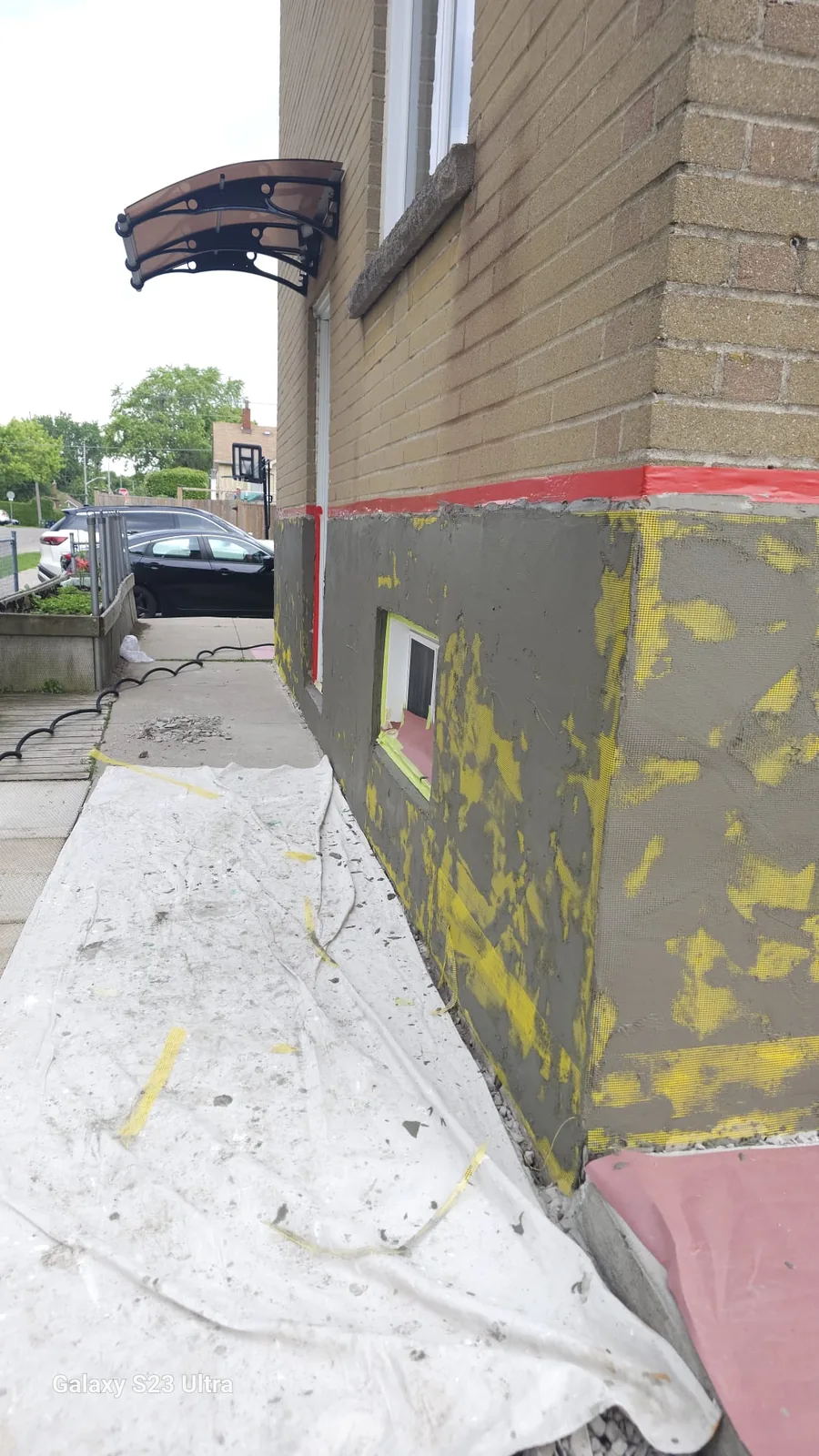
A base coat with fibreglass mesh, especially at corners and where movement is expected, then the finish coat, each at the right thickness and cured properly.
05Protect the top and bottom
Detail the top edge so water sheds off it, and fix grading, downspouts and splashback at the base.
Where FAIME fits
Parging is a self-performed FAIME scope across Toronto, North York, Scarborough, Vaughan, Richmond Hill, Markham, Mississauga, Brampton and the wider GTA, using Durabond and Sto systems. Our foundation refinishing project shows the whole sequence on a house: old material stripped, cracks repaired, a mesh-reinforced base coat, and a tinted finish. On our Vaughan commercial project, the parging was redone with the same Venetian finish as the walls above, so the base of the building matches. For a hiring checklist, see who does foundation parging in the GTA.
- $2M general liability · Active WSIB (Class G5) · 2-year workmanship warranty
- Written scope before work starts, including what comes off and what stays