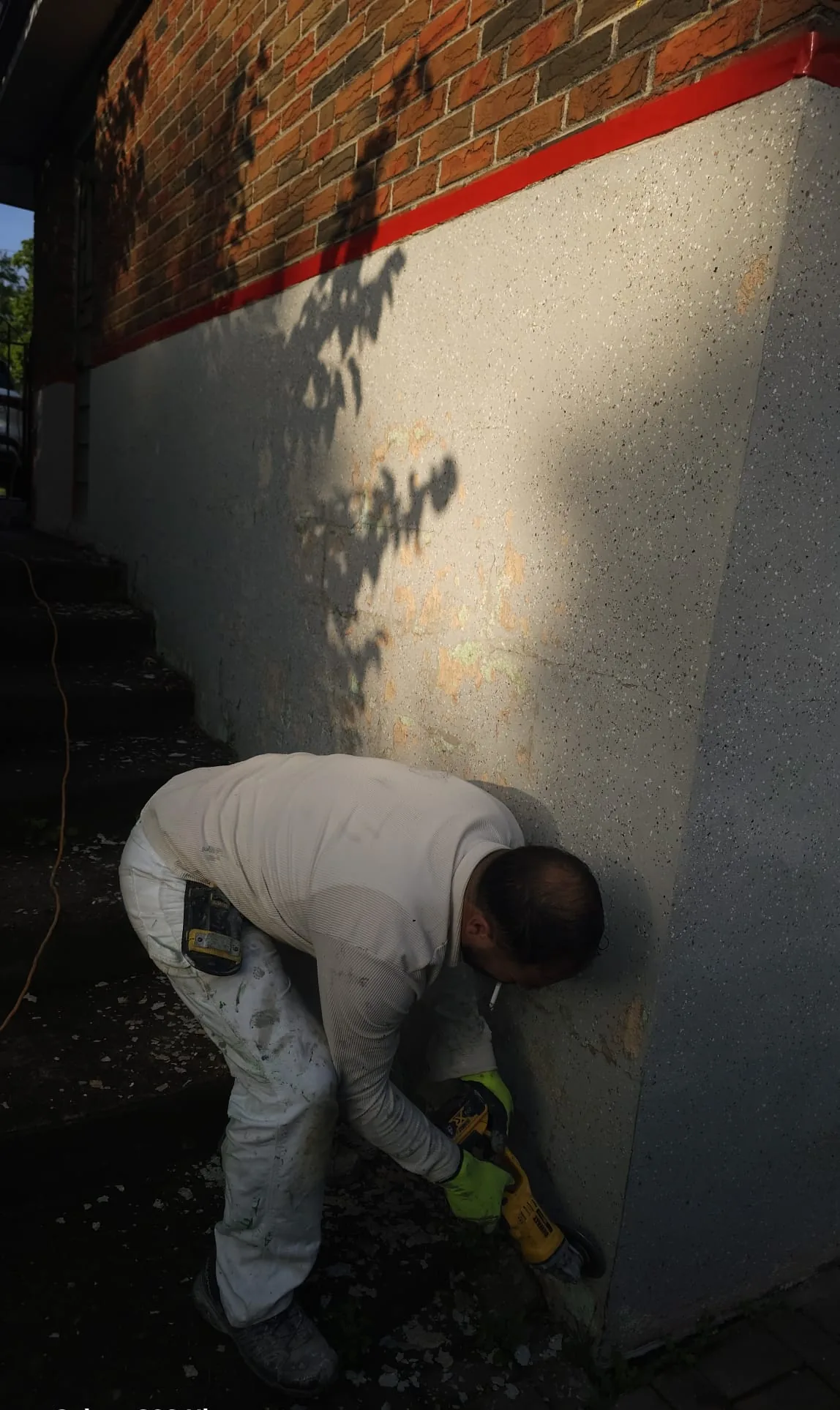
The three contractors who will quote your crack
Put a cracked exterior wall out to quote in the GTA and you will typically get three very different people through the door. They are not interchangeable, and the cheapest quote is almost always the one that solves the least.
1. The painter or handyman
Fills the crack with caulk or an elastomeric patch, paints over it, and leaves. This works on exactly one kind of crack — a hairline surface craze in a sound wall with no water getting behind it. On anything else it is a cosmetic lid on a live problem. The tell is the quote itself: if nobody asked to look at the inside of the wall, the roofline, or the window heads, nobody diagnosed anything.
2. The general renovator
Takes the job, then subcontracts the wall out. Sometimes that subcontractor is excellent. The problem is that you are now two steps away from the person holding the trowel, the diagnosis happens on the day work starts rather than on the day it was quoted, and if the finish does not match, the accountability chain has a seam in it.
3. The envelope contractor
Treats the crack as a symptom. Looks at where water enters the assembly, not just where the finish split. Prices the repair as a system — rout, reinforce, rebuild, re-coat — and tells you plainly when a crack is cosmetic and does not need the full scope. This is the one you want, and the one that costs the least over ten years.
The single best filter
Ask each contractor what the crack pattern means before you ask what it costs. A contractor who answers "cracks are normal, we'll fill them" is quoting a cosmetic job. A contractor who asks where the crack sits relative to your windows, corners and roofline is quoting a repair.
Why the pattern decides who you need
Cracks are not generic. A short list of what different patterns usually indicate on GTA walls:
- Diagonal cracks running off window and door corners. Stress concentration at an opening. Extremely common, usually repairable, but it needs mesh reinforcement across the corner — not filler. Fill it and it comes back in the same line within two seasons.
- Vertical cracks on a straight run of wall. Often a sheathing joint or a panel edge telegraphing through. Points to how the substrate was built, and to whether the base coat was reinforced properly the first time.
- Horizontal cracks at a consistent height. Frequently a transition — floor line, a change of substrate, a missing or failed flashing above. This is the pattern most likely to be wetting the wall.
- Map or spiderweb crazing over a broad area. Usually a finish-coat or mix problem rather than a structural one. Cosmetic in origin, but wide-area, so a patch will always read as a patch.
- Cracks with staining, efflorescence or soft finish around them. Water is already in the assembly. This is no longer a crack repair — it is a moisture investigation first.
We wrote the long-form version of this diagnosis — how to read direction, width, location and staining on a real wall — as a standalone technical guide: EIFS & Stucco Crack Repair: How to Read a Cracked Wall.
Seven questions that separate a patcher from an envelope contractor
Ask these on the site visit. You do not need to be technical — you need to hear whether the answers are specific.
- "What is this crack pattern telling you?" You want a diagnosis, not a reassurance.
- "Is this stucco or is this EIFS?" They look identical from the sidewalk and behave on opposite principles. A contractor who cannot tell you which one is on your wall — and how they established it — has not looked closely enough.
- "Are you routing the crack out, or filling it?" A crack that matters gets opened up, reinforced with mesh, rebuilt in base coat, then finished. Filling is for hairlines.
- "How will you match the existing texture and colour?" Ask specifically how they mock it up and where. Texture matching is a craft skill; colour on a weathered wall never matches the original spec sheet.
- "Where does the repair stop?" A good answer stops at a natural break — a corner, a reveal, a control joint — not in the middle of a wall where the patch edge will always be visible.
- "Are you checking the flashing and caulking above this?" If water is arriving from above, the repair is temporary regardless of how well it is done.
- "Who is actually on site — your crew or a sub?" Not disqualifying either way. But you should know before the work starts, not after.
What a proper repair scope actually contains
A written scope for a crack repair that will hold should name each of these steps. If a quote is one line and a number, there is nothing in it to hold anyone to.
01Assess and mark
Walk the elevation, map every crack, identify the pattern and the likely cause, and check the details above the crack — flashings, sills, caulked joints, roofline terminations.
02Rout and open
Grind the crack open into sound material so the repair has something to key into. This is the step budget quotes skip, and it is the step that decides whether the crack returns.
03Reinforce
Embed mesh across the crack and past it, so the repair spans the movement rather than sitting in it. Corners get additional reinforcement.
04Rebuild the base
Base coat back to plane, feathered so the repair does not stand proud of the surrounding wall under raking light.
05Match and finish
Texture and colour matched to the existing wall, taken out to a natural break line rather than stopped mid-elevation.
06Seal the details
Re-caulk failed joints and correct flashing details in the same visit, so the repaired wall is not re-wetted by the detail that caused it.
Where FAIME fits
FAIME Construction Inc. is a building envelope and finishing contractor working across Toronto and the GTA. EIFS, stucco and crack repair are self-performed by our own crews — the people who quote the wall are the people who repair it.
Practically, that means we do the site visit before we put a number on anything. We will also tell you when a crack is cosmetic and does not justify a full repair scope, which is a conversation that costs us work and saves you money.
- $2M general liability, with Additional Insured endorsements available
- Active WSIB coverage (Class G5)
- 2-year workmanship warranty; materials carry their own manufacturer warranties
- Durabond and Sto systems bought and installed
- Written scope before work starts — no pricing given before we have seen the wall
Two documented examples of this work on real walls: a Scarborough stucco refinishing project (grind, mesh, tinted finish, base caulking) and an exterior stucco white finish. Both pages show the same wall before, during and after.