Short answer
When paint or stucco fails on one side first, that side is getting more of something: sun, wind-driven rain, or water that never dries out. The sunniest walls (usually south and west) fade, chalk and crack first, because UV and daily heating and cooling break coatings and sealants down fastest there. The side facing the prevailing wind and weather takes the most driving rain and snow, so it shows cracking, water damage and failed joints first. Shaded walls, often north-facing or close to trees, stay damp and grow mildew, algae and moss. Water from a gutter, downspout, sprinkler or grade problem can make one section fail regardless of direction. Fix the cause on that side. Then decide whether to redo one side or the whole building, which usually comes down to colour match and how the other sides are ageing.
Read the failure, then the direction
The sunny side
- Fading and chalking, powder on your hand when you rub the wall
- Hairline cracking in the paint film
- Hardened, cracked caulking around windows and joints
- Dark colours hit hardest, since they absorb the most heat
The weather side
- Cracked stucco, especially off window corners
- Peeling and blistering from water getting behind the paint
- Efflorescence and staining below openings
- Leaks inside on that wall after storms
- The shaded, damp side: green or black growth, mildew, moss at the base, paint that stays soft or peels because the wall never fully dries.
- One section, whatever the direction: below a gutter or downspout, behind a sprinkler, where snow is piled, or where soil and mulch sit against the wall. That is a water source, not the weather.
Why the sunny side fails first
UV breaks down the binder in paint and the polymers in sealants, which is what turns a coating chalky and a caulking bead hard and brittle. On top of that, a wall in full afternoon sun heats up and cools down every day. That constant movement cracks paint films and tears tired sealant joints. The effect is strongest on south and west faces and on dark colours, which absorb the most heat. Reflected sun from large windows nearby can do the same thing to one section of a wall.
Why the weather side fails first
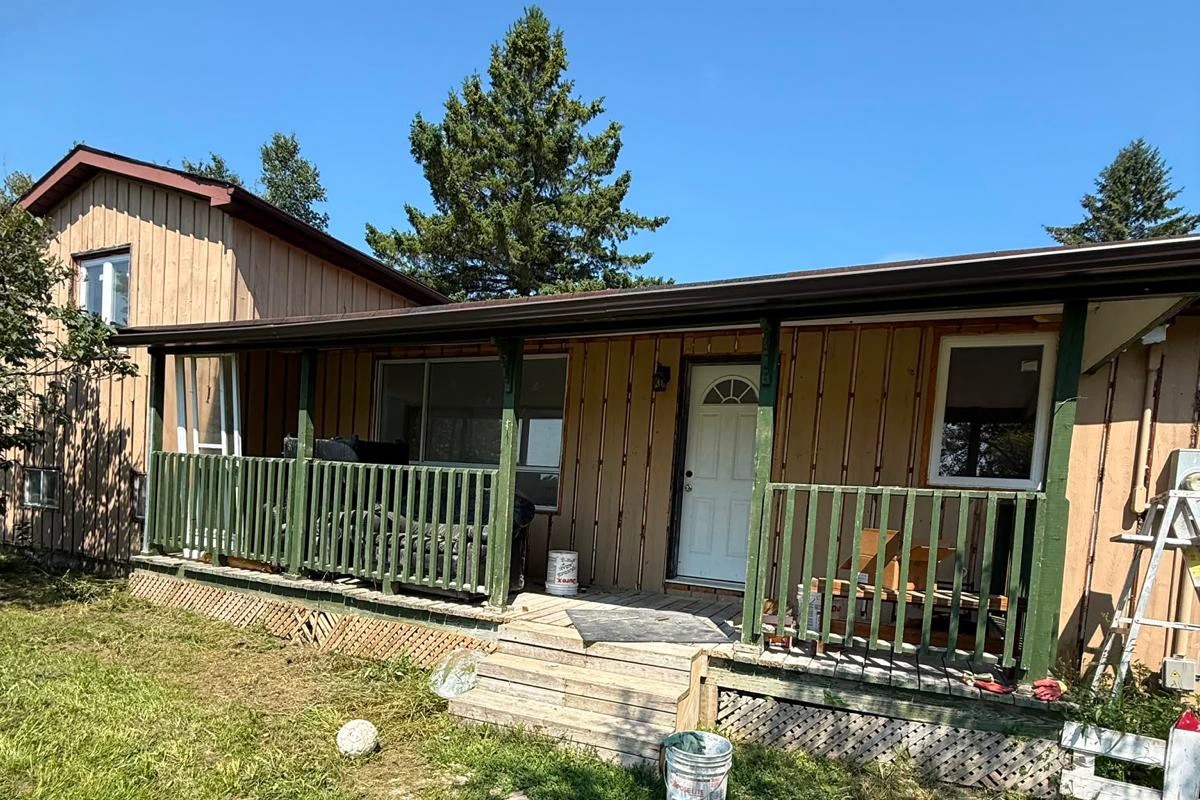
Rain rarely falls straight down in a storm. The side of a building facing the prevailing wind gets driven rain pushed against it and into every crack, joint and window perimeter, and it takes the drifting snow in winter. Water that gets in on that side then goes through freeze–thaw, so cracks widen and finishes debond faster there than anywhere else. On our Innisfil EIFS project, the failing face was the front elevation, the side that took the wind and the driving snow, and it was the one where the structure behind the boards had deteriorated worst.
Why the shaded side goes green
A wall that gets little sun, sits close to trees or a neighbouring building, or has plants against it, dries slowly after every rain. Mildew, algae and moss need exactly that: damp surfaces and little UV. The growth itself is mostly cosmetic and can be cleaned, but a wall that stays damp also holds paint less well and suffers more in freeze–thaw. Cutting back plants, improving drainage at the base and cleaning with a suitable product before repainting all help. See green or black growth on your walls for how to clean it safely.
Redo one side or the whole building?
Both can be the right answer. Things to weigh:
- Colour match. New paint on one side next to years-old, faded paint on the corner beside it will not match exactly, even in the same colour. A single elevation usually looks fine where it meets the others at a corner. It looks patchy when it stops mid-wall.
- How the other sides are ageing. If the sunny side has failed and the others are chalking too, they are a few years behind it, and doing everything at once is often cheaper than two mobilisations.
- Repairs come first either way. Cracks, open joints, failed caulking and water damage on the failing side get fixed before anything is painted, or the new finish fails the same way.
- Specify for the exposure. The side that failed first will fail first again. It is the elevation where coating choice, a second full coat and sealant quality matter most.
Where FAIME fits
Exterior painting, stucco and EIFS repair, and joint sealant and caulking work are self-performed FAIME scopes across Toronto, North York, Scarborough, Vaughan, Richmond Hill, Markham, Mississauga, Brampton and the wider GTA. We walk every elevation on a site visit and put in writing what each side needs, rather than pricing the whole building off its worst wall or its best one.
On our Vaughan commercial project, the repairs were done wherever each wall needed them, and then the whole building was painted in two full coats so every elevation finished the same colour.
- $2M general liability · Active WSIB (Class G5) · 2-year workmanship warranty
- Written scope per elevation before work starts