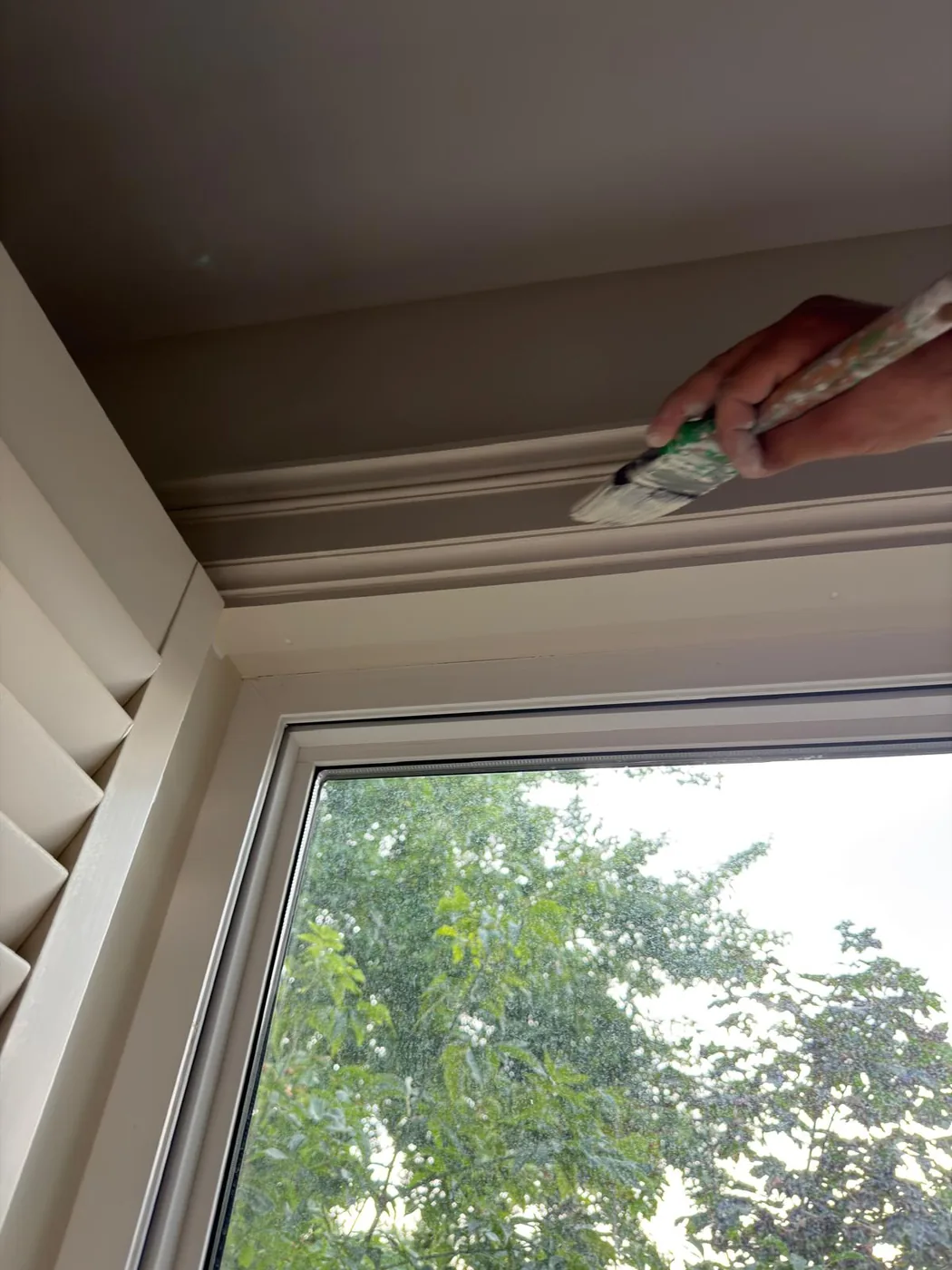
Peeling is a bond problem, not a paint problem
The instinct is to blame the paint, and it is almost never the paint. Coatings fail where they lost their grip on what is underneath — either because something got between the paint and the surface, or because water pushed it off from behind. A better product applied the same way over the same surface fails the same way.
That is why the useful question is not "what paint should I use", but "why did this one let go". Everything else follows from the answer.
Look at what is under the flake
Pick up a piece that has come off and look at its back, then look at the surface it came from. This tells you more than any amount of guessing.
Bare wood or bare substrate underneath
- The coating came away from the material itself
- Usually moisture from behind, or paint applied over a damp, dusty or unprimed surface
- This is the more serious version — something is feeding water to the back of the coating
Another layer of paint underneath
- The new coat let go of the old coat rather than the wall
- Usually a preparation failure: a glossy, chalky or dirty surface that was never sanded or primed
- Often confined to whichever elevation was done last
Then check where on the building it is happening. Failure concentrated on one elevation, or in a band low down, or directly under a window, is not random — it is pointing at the water source.
The four things that actually cause it
- Moisture reaching the back of the coating. The most common cause on exteriors, and the one that gets missed. A failed sealant joint at a window, an open flashing detail, a gutter overflowing down a wall, splash-back at grade, or a leak inside the wall. The wall gets wet from behind, the water tries to escape through the face, and it takes the paint with it. Repaint without fixing that and you have bought a repeat.
- Preparation that was skipped. Paint needs a clean, sound, dull surface. Applied over chalky oxidised paint, over dirt or pollen, over glossy unsanded enamel, or over bare wood with no primer, it has nothing to key into. This is the single most common cause on repaints, and it is invisible on the day the work is finished.
- The wrong coating for what is under it. Film-forming coatings over a surface that needs to breathe, an incompatible system over an old oil-based coat, or an interior-grade product used outside. The mismatch shows up a season or two later.
- Painted in the wrong conditions. Too cold, too hot, in direct sun on a hot wall, on a damp surface, or with rain arriving before the coating cured. The film skins before it bonds properly, and the failure appears the following year.
The gutter test
Stand back and look at where the paint is failing worst, then look directly above it. If a gutter, a downspout joint, a window sill or a flashing detail sits above the failure, you have very likely found your cause. Peeling that follows a vertical line down a wall is almost always water tracking from something above it, not a bad batch of paint.
Blistering, chalking, alligatoring: what each one means
Different failures point at different causes, and the words matter when you are talking to a contractor.
- Peeling or flaking — the coating has released in sheets or chips. A bond failure, from moisture or preparation.
- Blistering — bubbles under an otherwise intact film. Moisture or solvent trapped beneath, or paint applied onto a hot surface in direct sun.
- Chalking — a powdery residue on your hand when you rub the wall. Normal UV weathering of the binder, but a chalky surface must be washed and prepared or the next coat will not stick to it.
- Alligatoring — a cracked pattern like reptile skin. Usually a hard, brittle coat over a softer one, or too many layers built up over years.
- Staining or streaking through the paint — something is moving through from behind: water, tannin from wood, or efflorescence from masonry.
Why repainting over it does not work
A fresh coat over failing paint bonds to the failing paint, not to the wall. It inherits the failure underneath and comes off with it — usually faster than the coat before, because it has added weight and film thickness to a bond that was already losing.
This is why a cheap repaint on a peeling exterior can look excellent for one season and then fail across a whole elevation. Nothing was fixed; it was covered.
What belongs in a proper exterior repaint scope
01Find and fix the water first
Sealant joints, flashing, gutters and window perimeters get addressed before any coating goes on. If water is reaching the back of the paint, nothing applied to the front will last.
02Scrape back to sound material
All loose and flaking material removed — not feathered over. The edge of every remaining flake is the next failure line.
03Wash, sand and repair
Chalk, dirt and pollen washed off; glossy areas dulled; damaged wood repaired or replaced rather than painted over.
04Prime what needs priming
Bare substrate, repairs and stained areas get the appropriate primer. Priming bare wood is not optional, and a spot-primed repair is not the same as a primed wall.
05Caulk the perimeters
Window and door perimeters caulked to close the joint against water and air before the finish coats. On our own jobs this is standard, not an extra.
06Two finish coats, in the right conditions
Applied within the product temperature and humidity range, with enough time to cure between coats, and not onto a wall in full afternoon sun.
The clause worth having in writing
Ask for the preparation to be described in the quote as its own line, separately from the painting. Preparation is the majority of the labour on a proper exterior repaint and it is the part that gets quietly reduced to win a price. If prep is not itemised, you cannot tell what you are comparing between two quotes.
What to ask before you hire
- "Why did the last coat fail?" A contractor who has not formed a view on this is going to repeat it. This is the single best question you can ask.
- "What preparation is included, and is it itemised?" Scrape, wash, sand, repair, prime — each should be named.
- "What are you priming, and with what?" "We'll prime as needed" is not an answer.
- "Are the window perimeters being caulked?" If water is coming in there, paint will not stop it.
- "How many coats, and what is the product?" Specific product names in writing.
- "What is the workmanship warranty?" A firm answer means they expect the bond to hold.
Where FAIME fits
Painting is FAIME's largest self-performed trade — our own crews, not subcontracted — across Toronto, North York, Scarborough, Vaughan, Richmond Hill, Markham, Mississauga, Brampton and the wider GTA, interior and exterior, houses through to occupied institutional buildings.
Because we also do the envelope work — stucco, EIFS, flashing and caulking — we tend to look at peeling paint as a water question first and a coating question second. That is usually where the answer is.
- $2M general liability · Active WSIB (Class G5) · 2-year workmanship warranty
- Sherwin-Williams, Benjamin Moore and Dulux systems, specified in the quote
- Preparation itemised in writing, separately from the painting
On a recent Willowdale job we traced a leak, repaired the roof deck and flashing, and then repaired, caulked and repainted all twelve upstairs windows in a colour matched to a sample from the existing frame — that project is documented here. To get a wall looked at, the painting page has the site-visit form.