Short answer
You need a commercial painting contractor that self-performs, carries its own WSIB coverage and general liability, and can phase the work around occupancy — corridors, stairwells, amenity rooms, lobbies and common areas done in sequence, off-hours where required, with exits kept live and surfaces returned to service on schedule. For high-rise, institutional and large commercial buildings, the deciding factors are almost never brush technique. They are insurance limits and Additional Insured endorsements, WSIB standing, access equipment and working-at-height procedures, odour and VOC control in occupied space, and whether the contractor can hold a phasing schedule without your tenants noticing.
Why occupied-building painting is a different scope
The coatings are largely the same. Everything around them changes.
In an empty unit, the constraint is coverage. In an occupied building, the constraints are people, egress, hours, odour, dust, liability, and the fact that every surface you touch has to be back in service before the building wakes up. A contractor priced for the first job and dropped into the second will either blow the schedule or cut the preparation — and preparation is where paint jobs are actually won.
The rule that governs everything else
A paint job is roughly 80% preparation and 20% paint. In an occupied building, the preparation has to happen inside a window that other people are not using the space — which is why phasing, not painting, is the hard part of the estimate.
The compliance floor — verify before you shortlist
For a high-rise, school, institutional or large commercial property, these are not preferences. They are the minimum, and every one of them is verifiable with a document rather than a promise.
- Active WSIB coverage. Ask for a current clearance certificate, not a policy number. Clearance is what protects you from liability for an injured worker on your property.
- General liability at a limit that matches the building. Ask for the certificate of insurance and check the limit against what your property management or board requires.
- Additional Insured endorsement. Naming the owner and the property manager on the contractor's policy. Ask whether it is available before award, not after.
- Working-at-height and access procedures. Lifts, scaffolding, swing stages and ladders each carry their own requirements and their own training records. Ask what access method is planned and who is certified on it.
- Written phasing schedule. Which areas, in what order, during which hours, and what is back in service by when.
- Product data and safety data sheets. Particularly for occupied and institutional space, where odour and VOC content are a genuine constraint rather than a footnote.
Phasing: the part most quotes get wrong
A quote that prices the square footage but not the sequence is an incomplete quote. The questions worth forcing into the open before award:
- What hours does the crew actually work? Off-hours and overnight work costs more and needs to be priced in from the start, not discovered in week two.
- How many areas are open at once? More simultaneous areas means faster completion and more disruption. This is a decision the building should make deliberately.
- How is egress maintained? Stairwells and corridors are exit routes. They cannot simply be closed because they are wet. The plan should say how the route stays usable.
- What is the recoat and return-to-service time? This drives the whole schedule and depends on the specific product, temperature and ventilation — not on a general rule of thumb.
- How is odour managed? Ventilation, negative pressure where appropriate, low-odour and low-VOC product selection. In schools, care settings and residential corridors this is often the single most complaint-generating variable.
- What notice do occupants get? Who writes the notice, how far ahead it goes out, and what it tells people to expect.
- What happens to the floor? Protection, masking and daily clean-down. In a lobby or corridor, the flooring is usually worth more than the paint.
Questions that separate the two kinds of contractor
Answers that should worry you
- "We'll work around you" — with no schedule attached
- "It's low odour, nobody will notice" — with no product named
- "We can start Monday" — before anyone has seen the corridors
- "We'll get you the certificates later"
- A price per square foot with no phasing, no access method and no return-to-service times
Answers that indicate competence
- A named sequence of areas with dates and hours
- Specific products named, with data sheets offered
- A stated access method and who is trained on it
- Clearance certificate and COI produced on request, immediately
- Questions back at you about egress, hours, elevator access and occupant notice
What the preparation should actually include
Whatever the building type, the sequence that makes a coating last is the same, and it is the sequence that disappears from cheap quotes:
01Protect and mask
Floors, fixtures, hardware, signage, sprinkler heads and finishes protected before anything is opened.
02Wash, sand, patch, caulk
Adhesion is decided here. Contaminated, glossy or damaged substrate is why coatings fail early, not the paint.
03Prime correctly
The right primer for the specific substrate — new board, stains, previously glossed trim, patched areas. Skipping primer is the most common corner cut in commercial repaints.
04Two finish coats
Two coats minimum, checked under raking light rather than under the corridor downlights that hide everything.
05Return to service
Masking removed, hardware reinstated, area cleaned down and handed back within the window the schedule promised.
Where FAIME fits — stated precisely
Painting is one of the scopes FAIME Construction Inc. self-performs with its own crews, alongside EIFS, stucco, drywall, tile, trim and flashing and caulking. For everything FAIME self-performs there is no building-type restriction: houses, commercial storefronts, large commercial, multi-unit, high-rise and institutional buildings are all within scope, including occupied buildings.
Scope is not the same as a track record
We take on high-rise and institutional painting programs. We do not publish building counts, project totals or client names we have not been given permission to use. The completed work we are willing to point at is documented on our project pages, with photographs of the actual job. If a contractor's experience claims cannot be traced to something you can look at, treat them as marketing — including ours.
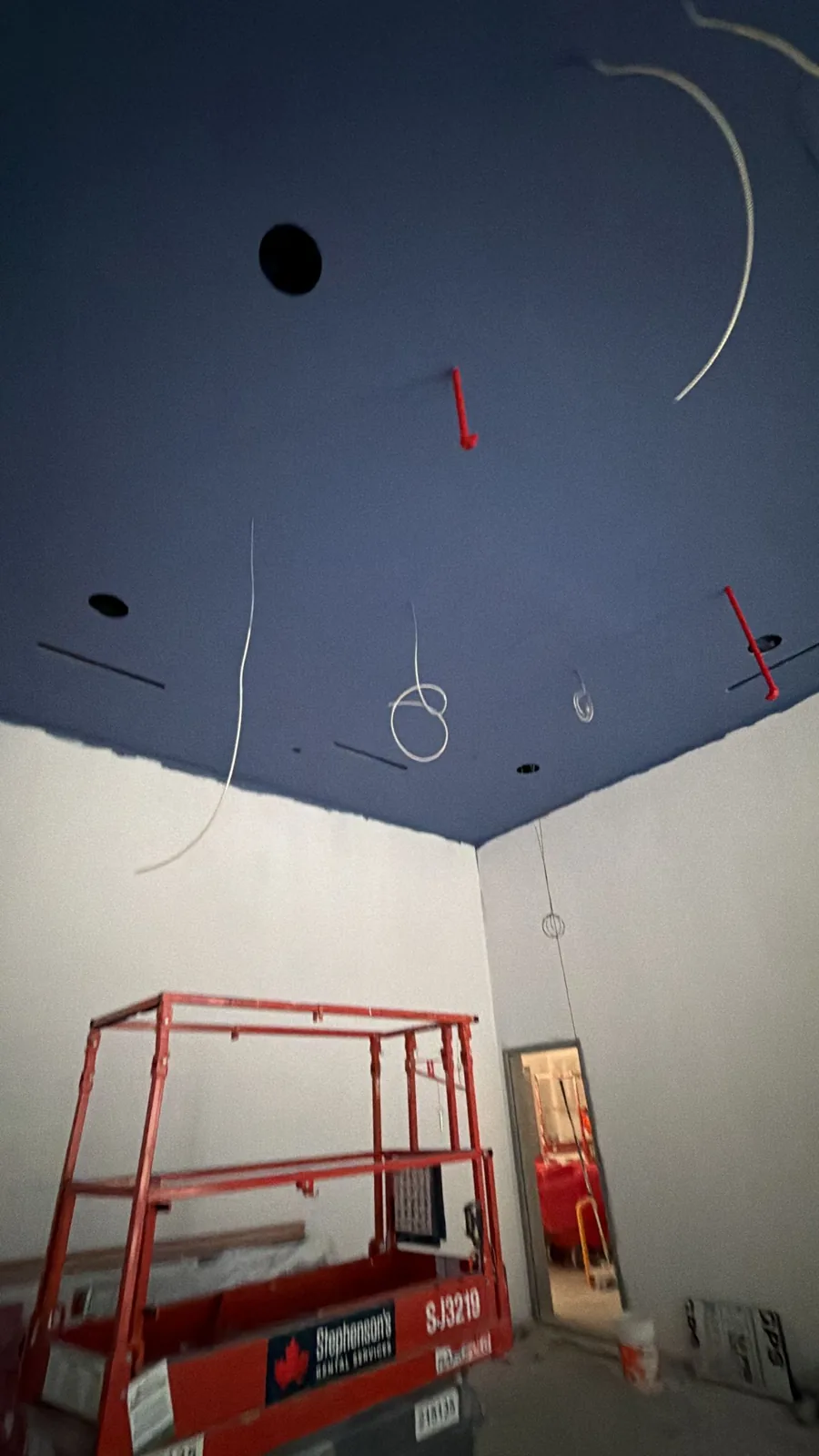
The clearest documented example is our Vaughan commercial envelope project: FAIME as general contractor on an occupied building, with repairs, new sealant joints and two full coats of paint finished in 7–10 working days while the tenant stayed open. Another is a commercial ceiling repaint in Scarborough — scissor-lift airless spray and back-roll, two coats, worked around the space in use. Our painting service page sets out the full interior and exterior scope.
- $2M general liability, Additional Insured endorsements available
- Active WSIB — Painting & Wall Covering Contractors, Class G5
- 2-year workmanship warranty; manufacturer warranties on materials
- Sherwin-Williams, Benjamin Moore and Dulux products bought and applied
- Crews scale from 1 to 10 on site depending on scope and phasing
- Site visit and written scope before any number is given
If you manage a property and want a scope written against your building rather than a rate quoted against a floor area, the property managers page is the right starting point.